Almost is the Same as Never
You cannot go back and start a new beginning. But you can start today and make a new ending.
Get the Book
Paperback from $11.99 · Kindle available · Ships worldwide
5.0 ★ from 9 readers · By Erlwin S. Abanggan and Ayo Gutierrez
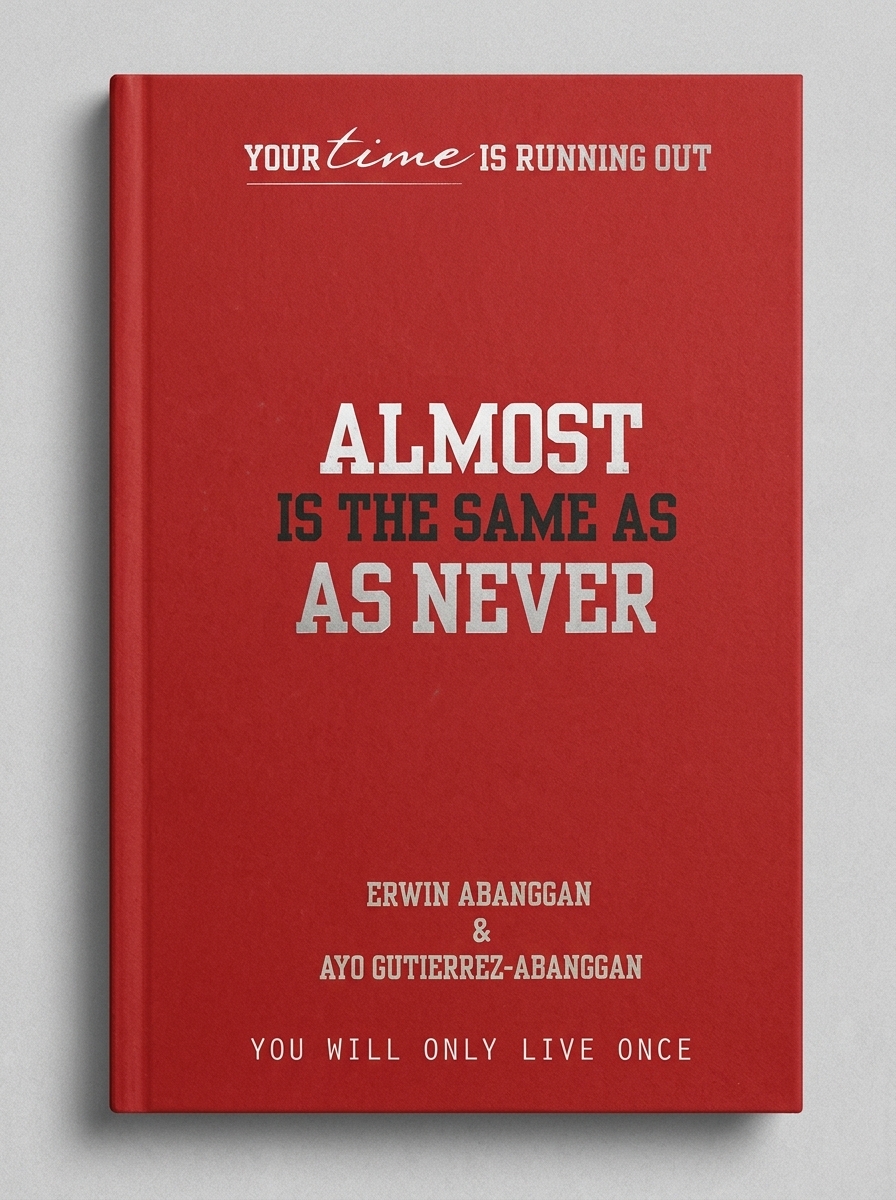
02 — At a glance
The book at a glance
A practical book about why the near-miss is the same as never — written by a financial planner and a publisher who have spent more than a decade saying it out loud.
- Authors
- Erlwin S. Abanggan & Ayo Gutierrez
- First published
- 2012
- Format
- Paperback, Kindle
- Paperback
- from $11.99
- Rating
- 5.0 ★ · 9 ratings
- Where to buy
- Amazon · National Bookstore · Powerbooks (nationwide, PH)
03 — What it says
What this book actually says
Almost is the same as never. Not similar. Not close. The same.
The near-miss is not progress toward the thing. It is the thing, unhad. The comfortable story — I'm almost there — is not a comfort. It is the mechanism that keeps you stuck.
The book does not ask you to feel better. It asks you to act.
The goal is creation, not yet perfection. What's important is you get started today.
— from the book's own description
04 — Why it's different
Why this isn't another motivational book
It treats almost as loss
The category celebrates the near-miss. "You're getting closer." "Keep going." This book names it as the thing it actually is: the result, unhad. That is the harder, more honest, more memorable position — and it is the entire reason the title works as a principle and not a slogan.
It is written by two authors, not one
Erlwin S. Abanggan is a Certified Associate Financial Planner (RFP Philippines) and a Senior Marketing Director at International Marketing Group, who has spoken to Filipino audiences in Dubai, Oslo, Barcelona, Auckland, Jeddah, Canada, Qatar, Macau, Singapore and Taiwan. Ayo Gutierrez is a publisher who has released nearly 400 authors through GMGA Publishing, a TV host, a poet, and a writing teacher. Two authors, two kinds of authority, one book.
It has been in print since 2012
The oldest review of this book is dated September 2012. It has been read, argued with, and re-published since. Most books in this category do not survive eighteen months. This one has survived a decade and a half.
05 — What it costs
What almost actually costs
"Almost" does not feel like losing. That is the problem.
- The almost-finished thing does not pay you.
- The almost-started thing does not exist yet.
- The almost-said thing was never heard.
The book's answer is not encouragement. It is a question: what if today is really your last day on earth?
06 — Is it for you
Who this is for — and who it isn't
This is for you if:
- You already know what you have been putting off.
- You have read other motivational books and they did not stick.
- You want to be told the truth, not told you're wonderful.
- You are ready to act today, not "when things calm down."
This is not for you if:
- You want comfort. The book does not offer it.
- You want a perfect book. It was reviewed in 2012 as having typos, and we would rather you know that now.
- You want a system with twelve steps. It has one instruction: start today.
- You are looking for a gift that flatters. This is not that.
Still not sure? See common questions →
08 — What's inside
What's inside
Fourteen years of the same argument, said more than one way — because one way was not enough to make it land.
The near-miss
Why "almost" is not progress — and why treating it as progress is the mechanism that keeps you stuck.
Time
What "your time is running out" actually means, when it stops being a metaphor and starts being arithmetic.
Regret
The specific regret that comes from almost — and why it is worse than the regret that comes from failure.
Action
Why starting today is the only move available, and why "soon" is not a plan.
Success, happiness, wealth
Why obtaining them is possible for those who make them so — and why that phrasing matters.
09 — Reader voices
What readers say
Nine ratings. Seven written reviews. One of them is three stars, and we are not going to hide it.
Good Thoughts
"This book has some great thoughts and stories. I would have rated it higher if it had been edited. If you can overlook the wrong word being used or typos, it's definitely worth reading."
We are not going to argue with that review. The book says the goal is creation, not perfection. A perfect book about imperfection would be a contradiction. What we will point out is that this review is dated September 2012 — and this reader still told you to read it.
Amazing content!
"Honestly it only took me less than 2 hours to read the entire book! And it is amazing. Almost achieving something is really the same as not achieving it. I call my self an INCURABLE OPTIMIST and if you are like me, an optimist, then this book is for you too!"
If you keep putting things off
"Easy, digestible read. WILL MAKE YOU want to TAKE ACTION even without having read the whole book yet."
Great book!
"2 thumbs up!!"
Life changing!
"I am spellbound by this book! It's an eye opener to the possibilities that we have everyday. I was feeling so down & depressed & this book gave me a whole new perspective on life! Thank you to the author! It's a great read!"
You Can Do It!
"Is life passing you by while you dither? This book will help you start doing those things that you have been dreaming of and considering unreachable. A guide to a 'can do' life."
Good book!
"Very motivational"
Reviews reproduced verbatim from the book's Amazon listing.
10 — Formats and pricing
Formats and pricing
Paperback from $11.99. Kindle available. Ships worldwide.
Paperback
from $11.99
Kindle
View on Amazon
- Title
- Almost is the Same as Never: Your Time is Running Out
- Authors
- Erlwin S. Abanggan & Ayo Gutierrez
- First published
- 2012
- ISBN-10
- 1653790709
- Page count
- —
- Publisher
- GMGA Publishing
Get the Book
Paperback from $11.99 · Ships worldwide · No account needed to buy
11 — If it doesn't land
If it doesn't land
Buy it through Amazon and you are covered by their standard return policy. If the book does not move you, you are not stuck with it.
We are not going to invent a guarantee we cannot honor. What we will say is this: the book has been read since 2012 by people who were stuck, and one of them wrote that it gave them "a whole new perspective on life." If it does not do that for you, return it.
12 — Questions
Frequently asked questions
The six questions readers ask before they buy.
What is the book actually about?
It argues that "almost" — the near-miss, the almost-finished, the almost-started — is functionally the same as "never." It is a practical book about acting today instead of soon.
Who wrote it?
Erlwin S. Abanggan, a Certified Associate Financial Planner (RFP Philippines) and Senior Marketing Director at IMG, and Ayo Gutierrez, a publisher who has released nearly 400 authors through GMGA Publishing. They are married.
Is it religious or spiritual?
No. It references The Secret in its own description, but the argument is practical, not spiritual.
How long does it take to read?
One reviewer finished it in under two hours. It is short by design.
I saw a review that mentions typos. Should I worry?
That review is real and we kept it on this page. It is dated 2012. The book has been revised since — the Second Edition exists — and the same reviewer still wrote "it's definitely worth reading." A perfect book about imperfection would be a contradiction.
Where can I buy it?
Amazon, and at National Bookstore and Powerbooks nationwide in the Philippines.
Still have questions? Read the full FAQ →
Your time is running out.
Get the BookPaperback from $11.99 · Ships worldwide · No account needed to buy
14 — Also by these authors
Also by these authors
Seven more books, the same argument, from different angles.
- Almost is the Same as Never: Second Edition
- Chooseday: Life is a Matter of Choice
- Buy 1 Fake 1
- Evocare: A Collection of Tanka
- Bards from the Far East: Anthology of Haiku and Kindred Verses
- Chiaroscuro: Poetry Translated into French, Italian and Spanish
- YEARNINGS
Why almost
Why almost is the same as never
Because "almost" is not a stage on the way to the result. It is the result, unhad.
The phrase sounds like a paradox. It is not. It is an accounting.
The thing you almost did is not in the world. The thing you almost said was not heard. The thing you almost finished does not exist in any form that anyone — including you — can use. "Almost" is the language we borrow to describe the outcome we did not get, in words that sound like we got somewhere.
This page exists to make that accounting visible. Not to argue with you. Not to motivate you. To state the arithmetic.
What "almost" actually means
Almost is the word we use to describe the thing we did not do, in language that sounds like we did something.
Consider the sentence "I almost finished the report." The verb is finished. The tense is past. The grammar is the grammar of completion. And yet the report is not finished. The sentence describes an absence using the vocabulary of presence.
This is not a quirk of English. It is a universal defense mechanism. Every language has a way of letting the speaker hold two contradictory ideas at once: I did not do it and I am a person who does things. "Almost" is the word that holds them together.
The problem is not the word. The problem is that the word works. It protects you from the discomfort of the actual accounting. It lets you keep the identity of someone in motion while remaining exactly where you were. The relief is real. The progress is not.
When you say "I'm almost there," what you are actually saying is: I have not arrived, and I would rather not sit with that. The word buys you a moment of peace. It costs you the thing you were trying to finish.
What "never" actually means
Never is not a dramatic word. It is an accurate one.
"Never" sounds like an exaggeration. It sounds like the language of someone being hard on themselves, or someone being hard on someone else. It sounds like a curse.
It is not. "Never" is the plain description of a thing that did not happen. If you did not finish the report, then the report is not finished. If you do not start the book, then the book does not exist. If you do not say the thing, the thing was not said. There is no softer word for this that is also true.
The reason "never" feels harsh is that it removes the middle ground that "almost" pretends to occupy. There is no middle ground. The middle ground is a linguistic artifact — a comfort word — not a place where anything actually lives.
Which means the gap between almost and never is zero. They describe the same state. The only difference is how the state feels to the person describing it.
Why the difference matters
If almost and never are the same, then "I'm almost there" is not encouragement. It is a warning.
The motivational category tells you to celebrate the near-miss. "Look how far you've come." "You're almost there." "Keep going." This is not always wrong — sometimes it is the accurate description of a project genuinely in progress, with a real next step and a real calendar date. But the near-miss is only progress if it is *on the way* to the result. If it has become a place you live, it is not progress. It is the outcome, wearing a costume.
The tell is simple. Ask yourself: what is the next specific thing I will do, and when will I do it? If you have a specific answer with a real date, you are in progress. If your answer is "soon," "when things calm down," "once I figure out the right approach," you are not in progress. You are almost. Which is the same as never.
This is uncomfortable to read. It is supposed to be. Comfort is the mechanism that has been keeping the unfinished thing unfinished. The book's whole argument is that the comfort is the trap.
What to do about it
One instruction, five concrete ways to obey it: start today. Not soon. Today.
-
01
Name the thing you have been almost-doing. Say it out loud in one sentence. Not the category. The specific thing. "I almost wrote the book" is not the answer. "I have not written chapter three" is.
-
02
Identify the smallest possible first move. Not the plan. Not the strategy. The first action — something you could do in under fifteen minutes, today. A sentence. A phone call. A single line of code.
-
03
Do it before the end of today. Not tomorrow. Not after the current thing. Today. The point is not the action's size. The point is breaking the pattern that almost is a place where things can live.
-
04
Accept that the first version will be bad. The book's own line: the goal is creation, not yet perfection. The first draft is supposed to be rough. The first version is supposed to be wrong. The point is to move from "nothing" to "something," because "something" can be improved and "nothing" cannot.
-
05
Do not wait for the right time. There is no right time. There is only the time you have, and the thing you do with it. The subtitle of the book is not a metaphor — your time is running out is the arithmetic of every day you spend waiting for a better day.
Questions about the principle
Is "almost" ever actually progress?
Yes — when it is on the way to a specific, dated next step. If you can name the next concrete action and when you will take it, you are in progress. If the answer is "soon" or "when things calm down," you are not. The test is whether the near-miss has a calendar attached to it.
Isn't this just a hard version of "don't procrastinate"?
No. Procrastination advice tells you to start. This argument tells you to stop calling it progress when you have not. The two are different. You can procrastinate on something you have stopped pretending to be close to finishing — that is a different problem, and it is easier to solve because you are no longer defending the near-miss.
What about things that genuinely take years?
Long projects are fine. Almost does not apply to a project with a real next step. It applies to the state where the next step does not exist and has not existed for a while. If the work is genuinely moving — with dated milestones and visible output — you are not almost. You are in it. That is the correct state to be in.
Does this apply to small things, or only to big ones?
Both. The mechanism is the same at every scale. The unsent message, the unstarted draft, the un-booked flight, the unwritten book — each one has an "almost" you can hide behind, and each one resolves into a "never" if you keep hiding. The size of the thing does not change the arithmetic.
What if I have failed at the thing before?
Failure is a result. Almost is the absence of a result. They are not the same, and failure is not the failure mode this argument is about. If you tried and it did not work, you learned something and you can adjust. If you never tried, you have nothing to adjust and nothing to learn. That is a worse state, even though it hurts less.
What is the single most important thing on this page?
The line from the book: you cannot go back and start a new beginning, but you can start today and make a new ending. Everything else on this page is an explanation of why that line is the correct response to the arithmetic. The line is the action. The rest is context.
The book is the argument, in full.
Get the BookPaperback from $11.99 · Kindle available · Ships worldwide
The authors
Erlwin S. Abanggan and Ayo Gutierrez
A financial planner and a publisher. Married. Co-authors of seven books, including this one.
They met, they wrote, and they have spent more than a decade saying the same thing from two different angles. Erlwin explains it to audiences of financial professionals. Ayo explains it to writers and readers. The argument is the same. The rooms are different.

Erlwin S. Abanggan
Certified Associate Financial Planner · Senior Marketing Director
Erlwin is a Certified Associate Financial Planner by RFP Philippines and a Senior Marketing Director at IMG (International Marketing Group). His work is financial literacy — teaching people how money actually behaves, and how their decisions about it compound or don't.
He has built teams in Dubai, Oslo, Barcelona, Auckland, Jeddah, Canada, Qatar, Macau, Singapore, and Taiwan. His message travels because it is simple: success, happiness, and wealth are possible for those who make them so — which is a statement about action, not about luck.
He is a member of The Queen City Toastmasters Club and speaks publicly on leadership, financial planning, and the discipline of finishing what you start. His books — Almost is the Same as Never and Buy 1 Fake 1 — are sold at National Bookstore and Powerbooks nationwide in the Philippines.
Credentials
- Certified Associate Financial Planner — RFP Philippines
- Senior Marketing Director — IMG (International Marketing Group)
- Public speaker — Dubai, Oslo, Barcelona, Auckland, Jeddah, Canada, Qatar, Macau, Singapore, Taiwan
- Member — The Queen City Toastmasters Club
- Author — Almost is the Same as Never
- Co-author — Buy 1 Fake 1
- Distributed nationwide — National Bookstore, Powerbooks

Ayo Gutierrez
Publisher · Poet · TV Host · Professional Speaker
Ayo is a writer, editor, publisher, TV personality, and professional speaker. She is the author and co-author of several bestselling poetry collections — Evocare: A Collection of Tanka, Bards from the Far East: Anthology of Haiku and Kindred Verses, Chiaroscuro: Poetry Translated into French, Italian and Spanish, and YEARNINGS — and she is the co-author of Almost is the Same as Never: Second Edition and Chooseday: Life is a Matter of Choice.
As a publisher, she has released nearly 400 local and international authors under her online publishing platform, GMGA Publishing. She studied Communication Arts at De La Salle University and is pursuing further studies at Brigham Young University.
She was the main host of Travel Art TV on One Media TV 44 (formerly GNN TV 44). Her love-story episode on Maalaala Mo Kaya — "Destined to Love You," starring McCoy De Leon and Maris Racal and directed by Barry Gonzales — aired in May 2019 and became one of the show's most-loved episodes of all time. It trended on Twitter during its original broadcast.
Work & affiliations
- Founder and publisher — GMGA Publishing (nearly 400 authors)
- Author — Evocare, Bards from the Far East, Chiaroscuro, YEARNINGS
- Co-author — Almost is the Same as Never: Second Edition, Chooseday: Life is a Matter of Choice
- Former main host — Travel Art TV (One Media TV 44, formerly GNN TV 44)
- Communication Arts — De La Salle University
- Further studies — Brigham Young University
- Welfare and Self-Reliance Services Manager — Visayas Region (2014–present)
- President — City of Angeles Toastmasters Club (2022–2023)
- Charter President — Pinoy Writers Toastmasters Club
- Featured on Maalaala Mo Kaya — "Destined to Love You" (May 2019)
Together
Two careers, one argument. They have been building it for more than a decade — from opposite sides of the same idea.
Erlwin's work is about money and the decisions that make it work. Ayo's work is about writing and the discipline that makes a book exist. These are the same argument in two languages. Money is a decision you make or don't. A book is a manuscript you finish or almost finish. Both are the arithmetic of "almost," applied to a different material.
They wrote Almost is the Same as Never together, and they wrote its Second Edition together. They also co-authored Buy 1 Fake 1. Their books are available at National Bookstore and Powerbooks nationwide in the Philippines, and through Amazon internationally.
The line that closes their book is the line that names the whole project: you cannot go back and start a new beginning, but you can start today and make a new ending. That is what they are offering. Not a system. Not a formula. A sentence that is true, and an invitation to act on it.
Read the book they wrote together.
Get the BookPaperback from $11.99 · Kindle available · Ships worldwide
FAQ
Frequently asked questions
Questions about GMGA Publishing, speaking engagements, the other books, and how to reach the authors.
What is GMGA Publishing?
GMGA Publishing is the publishing platform founded by Ayo Gutierrez. It has released nearly 400 local and international authors.
Are the authors available to speak?
Yes. Erlwin S. Abanggan speaks internationally on financial literacy and leadership, and Ayo Gutierrez speaks on writing, publishing, and communication. Inquiries go to gmgapublishing@gmail.com.
Are the other books available on Amazon?
Yes. Almost is the Same as Never: Second Edition, Chooseday: Life is a Matter of Choice, and Buy 1 Fake 1 are available on Amazon, along with Ayo Gutierrez's poetry collections.
Is there a bulk or gift option?
For bulk orders and gift copies, contact gmgapublishing@gmail.com.
How do I contact the authors?
Email gmgapublishing@gmail.com, or use the contact form on this site.
Is the book available in Filipino?
The book is published in English. For translation inquiries, contact GMGA Publishing.
What is the Second Edition?
The Second Edition is a revised release of Almost is the Same as Never. The original was first published in 2012.
How do I submit a manuscript to GMGA Publishing?
Submissions go to gmgapublishing@gmail.com, or through the enrollment pages at inkyourlegacy.com.
Contact
Contact
For speaking engagements, publishing inquiries, or questions about the book.
Privacy Policy
Last updated: [date to be set at launch]
This Privacy Policy describes how Almost is the Same as Never (the "Site") collects, uses, and shares information when you visit or use the Site.
Who we are
The Site is operated by GMGA Publishing on behalf of the authors, Erlwin S. Abanggan and Ayo Gutierrez. The Site's contact email is gmgapublishing@gmail.com.
What we collect
We collect information in three ways:
- Information you provide. When you submit the contact form, we collect your name, email address, the subject you select, and the message you write. We use this information only to reply to your inquiry.
- Information collected automatically. When you visit the Site, our hosting provider and any analytics service may log standard request data — IP address, browser type, referring URL, pages viewed, and timestamps.
- Cookies. The Site itself does not set cookies. External services (fonts, analytics, if any) may set their own cookies. See the third-party section below.
How we use information
We use the information we collect to:
- Reply to messages you send through the contact form.
- Understand which pages are visited, so we can improve the Site.
- Comply with legal obligations, if any apply.
Third-party services
The Site uses or may use:
- Google Fonts — to load the typefaces Fraunces and Inter. Google's font service may log your IP address when the font files are requested.
- Form processing — the contact form is delivered through a third-party form service. That service receives the contents of your submission.
- Analytics — if analytics is enabled, a third-party analytics provider receives aggregate usage data. Analytics is not used to identify individual visitors.
- Amazon — links to the book's Amazon listing lead to Amazon's site. Amazon's own privacy policy governs what happens after you click.
Sharing
We do not sell or rent your personal information. We share information only with the third-party services listed above, and only to the extent necessary for them to provide their service.
Your rights
Depending on where you live, you may have the right to access, correct, or delete the personal information we hold about you. To exercise any of these rights, email gmgapublishing@gmail.com.
Data retention
Contact form submissions are retained only as long as needed to reply and to keep a reasonable record of correspondence. Analytics data is retained according to the analytics provider's own retention policy.
Children
The Site is not directed at children under 13 and we do not knowingly collect personal information from them.
Changes
We may update this policy from time to time. The "Last updated" date at the top will reflect the most recent change.
Contact
Questions about this policy: gmgapublishing@gmail.com.
Terms of Service
Last updated: [date to be set at launch]
These Terms of Service ("Terms") govern your use of the Site. By visiting or using the Site, you agree to these Terms.
What this site is
The Site provides information about the book Almost is the Same as Never: Your Time is Running Out and its authors, Erlwin S. Abanggan and Ayo Gutierrez. The Site also provides a contact form for inquiries.
What this site is not
The Site is not a store. Books shown on the Site are sold through third parties — primarily Amazon, National Bookstore, and Powerbooks. Your purchase of any book is governed by the seller's own terms, not by these Terms.
Content and copyright
All text, images, illustrations, and design on the Site are the property of the authors or are used with permission. You may not reproduce, republish, or redistribute Site content without prior written permission, except for short quotations with attribution.
Third-party reviews
Reader reviews shown on the Site are reproduced verbatim from the book's Amazon listing. They remain the property of their original authors and are quoted here for informational purposes only.
No advice
The book, the Site, and any content therein are for general informational and motivational purposes. They do not constitute financial, legal, medical, or professional advice. For advice specific to your situation, consult a qualified professional.
External links
The Site contains links to external websites — including Amazon, inkyourlegacy.com, and social media platforms. We are not responsible for the content, policies, or practices of those sites.
Limitation of liability
The Site is provided "as is." To the fullest extent permitted by law, the authors and GMGA Publishing disclaim any liability arising from your use of the Site or reliance on its content.
Changes to these Terms
We may update these Terms from time to time. The "Last updated" date at the top reflects the most recent change. Continued use of the Site after a change constitutes acceptance of the updated Terms.
Contact
Questions about these Terms: gmgapublishing@gmail.com.